
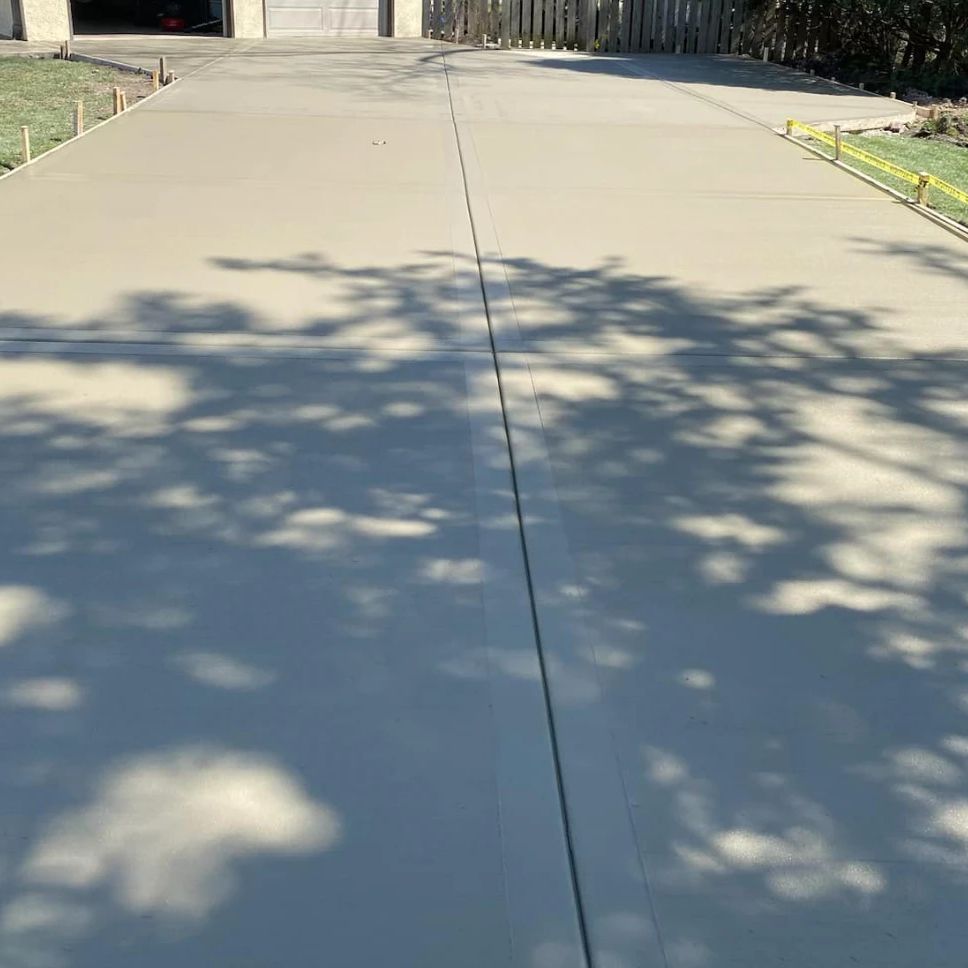
How Mudjacking Works
A slab sinks when the ground under it gives way. The usual culprits are fill that was never compacted, soil washed out by water running under the edge, or soil that shrank. The concrete itself may be fine. It is resting on a hole.
Mudjacking fills that hole from above. The crew drills a pattern of holes through the slab, which Concrete Network describes as typically 1 1/2 to 2 inches across, and pumps a grout of water, portland cement and sand or a similar fine filler through them. The grout first fills the empty space. Once the space is full, the pressure builds and lifts the slab. The crew works from the lowest point, moving from hole to hole so the slab comes up evenly, then patches the holes with mortar.
The patches stay visible. On a lifted slab, the row of plugged holes is often the first thing you notice. Lifting too much at one hole can crack the slab, and grout can push out at a joint or travel under the next panel, so the result depends on the operator as much as on the method.
Mudjacking vs Foam Concrete Lifting
Foam lifting replaces the grout with a two-part polyurethane. The two liquids mix at the tip of the injection gun, and the foam expands under the slab with enough force to fill the void and raise the concrete. The drilling and patching work the same way. The differences are in the material.
| Mudjacking | Foam lifting | |
|---|---|---|
| What goes under the slab | A cement grout: water, portland cement and sand or a similar fine filler. | A two-part polyurethane foam that expands as it reacts. |
| Holes in the slab | Larger holes, drilled in a pattern across the panel. | Smaller holes, as a rule. |
| Weight added to the ground | Heavy. The grout adds load to soil that has already settled once. | Light. The foam adds little load. |
| Back in use | The grout needs time to set before heavy loads. | Cures in far less time. |
| What can go wrong | Grout leaking out at joints, or lifting the wrong panel. | The same risk of cracking a slab that is pushed too far at one point. |
| What neither one does | Change the soil, stop water getting under the slab, or lower a slab that heaved. | The same. |
Method descriptions: Concrete Network, slab jacking and polyurethane foam guides.
Foam costs more per square foot, and grout is the older method with decades of use on walks and driveways. Picking between them matters less than the question both share: why did the slab sink, and has that stopped?
Which Sunken Slabs Can Be Lifted
Lifting is a good answer for a narrow set of slabs. A slab that fits all four of these is worth a call to a concrete leveling company before anyone talks about new concrete.
- It sank in one piece
The panel tipped or dropped but is not broken into loose pieces. Lifting raises a slab as a unit. It cannot reassemble one.
- It dropped below its neighbors
A low panel with a lip at the joint is the classic case. A panel that stands high, or a hump in the middle, is frost or something pushing up, and lifting does nothing for that.
- The ground has stopped moving
A walk that dropped after the house was built and has held still for years is a far better bet than one that moves a little more each spring.
- The surface is still sound
Concrete that is scaling across most of its surface is failing at the top. Raising it puts the same worn surface back at grade.
A lifted stoop is a special case. Steps poured against a house often sit on backfill beside the foundation, and loose backfill can keep settling for years. Stoops also carry a code footing rule that floating slabs do not, which is covered with steps and stoops that pull away from the house. Garage floors have their own complications, and the garage floor version of this decision has its own page.
Driveway panels, walks and patio slabs are the usual lifting jobs. Roof water from a downspout that empties beside a slab is one common way a panel settles, and the downspout has to be dealt with too, or the water keeps working under the slab after it is lifted.
Why Slab Jacking Fails in Chippewa Valley Frost
Lifting fills a void. It does not change what made the void, and in western Wisconsin the ground under a slab freezes and thaws every year.
Frost heave needs three things at once: frost-susceptible soil, available water and freezing temperatures. The cold is a given here. Lifting changes neither of the other two. If water reaches the soil under a lifted slab, the slab can heave in January and settle back unevenly in April, and the lift is undone in one winter.
Eau Claire Sand, Chippewa Valley Silt and Fill
NRCS soil maps show most of the land in Eau Claire as deep, excessively drained sand, led by Plainfield loamy sand, which the agency rates low for frost action. That rating describes natural ground. It says nothing about fill, leftover topsoil or water trapped against a foundation, and those are exactly what sit under most sunken walks, stoops and driveway edges beside a house. Native sand that drains well is no guarantee for the strip of backfill next to the basement wall.
Not all of the valley is sand. NRCS also maps silt loams in the area, such as Seaton, formed in windblown silt and rated high for frost action. Silty ground holds water and heaves hard, and a slab lifted on it is more likely to move again than one on clean sand.
Lifting Raises a Slab but Never Lowers One
Grout and foam push up. They cannot pull a slab down. When one panel heaves above its neighbors, a lifting crew can raise the neighbors to meet it, but the high panel stays where frost left it until the ground settles. Frozen ground settles when it thaws, so some heaved panels drop back partway on their own, and some do not.
Timing matters for the same reason. WisDOT notes that in spring the ground thaws from the top down, so thawed soil can sit above frost and hold water that cannot drain. A slab judged in March may still be riding on frost. Wait until the ground has fully thawed and watch the slab through one season before paying anyone to lift it.
What Mudjacking Costs
The figures here are national published ranges. No verified Eau Claire or Wisconsin price data exists for concrete lifting. HomeAdvisor’s cost guide, page updated June 2026, puts mudjacking at $3 to $6 per square foot and polyurethane foam lifting at $5 to $25 per square foot. These are typical national figures, not a quote, and they are not our prices, because we do not lift slabs.
A lifting company prices the job after seeing it. Four things move the number most.
- The size of the void
A slab with a deep hollow under it takes more grout or foam than one that dropped half an inch.
- How many panels
Each slab gets its own holes. Three walk panels are more drilling and patching than one.
- Grout or foam
Foam costs more per square foot in national price guides, and companies use their own formulas.
- Fixing the cause
Moving a downspout or regrading a low spot is separate work, and without it the price buys a lift that may not last.
Concrete Lifting vs Replacement: When New Concrete Wins
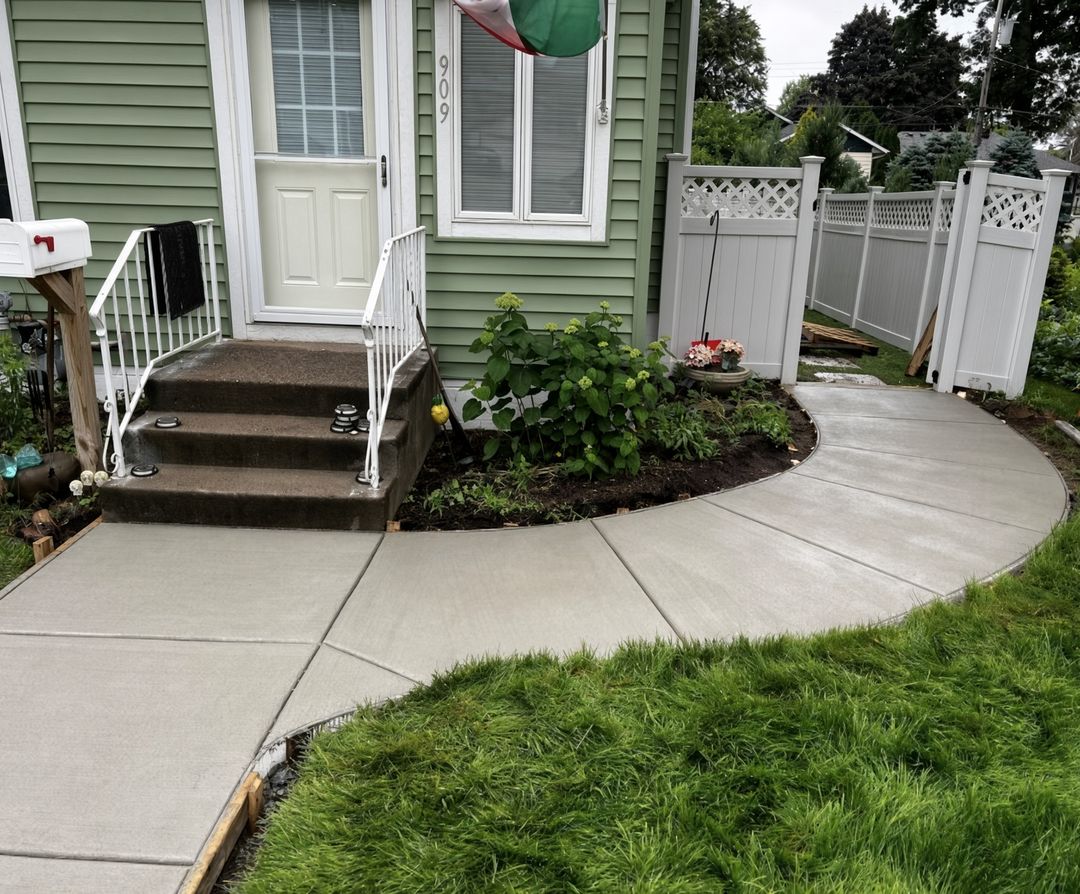
Replacement is the bigger job. It is also the only one that reaches the ground. When the concrete comes out, soft or washed-out base can be dug out and rebuilt, and the slab can be repoured with a pitch that sends water away instead of under it. That is the trade we work in, and it is the better answer in these cases:
- The slab is broken into pieces that move. Lifting raises a whole panel. Loose pieces come up unevenly and keep rocking.
- It heaved, or heaves every winter. Lifting cannot lower it, and the water and soil that push it up are still there.
- It was lifted before and sank again. A second sinking means the cause was never fixed.
- The surface is scaling across most of the slab. Raising it puts failed concrete back at grade.
- The slope is wrong. A patio that drains toward the house needs a new pitch and often a new base, and a lift only puts the old slab back where it was poured.
When only part of a slab has failed, the bad panels can often be cut out at the joints and poured new, which our guide to patching, cutting out and replacing failed concrete walks through surface by surface. For a whole driveway, see full driveway replacement in Eau Claire. A patio that has tipped or broken up is covered under tearing out a tipped patio. The public sidewalk along the street is the owner’s responsibility in Eau Claire, and the City’s rules for the public sidewalk explain the repair program and who answers for what. Ask Engineering at 715-839-4934 before anyone drills a public sidewalk panel.
Questions to Ask a Mud Jacking or Foam Lifting Company
Ask these of any lifting company, and ask us the matching ones when the talk turns to replacement.
- What made the slab sink? The answer should name a cause, such as a downspout, a washed-out edge or settling backfill, and say what will be done about it.
- Grout or foam, and why for this slab? Ask what the choice changes here, not in general.
- Where do the holes go, and how are they patched? The patches will show. Ask to see a finished job.
- How far will it come up? Ask whether the panel can come all the way back to its neighbors without cracking, and what happens at a joint that has chipped.
- What if it settles again? If the company offers a warranty, Wisconsin’s home improvement rule requires it in writing, with its conditions, limits and the time to make a claim.
- Is there a written contract? Driveways, sidewalks and patios fall under the same rule, and when you pay anything before the work is finished it calls for a signed contract stating the work, the price and the dates.
When a Slab Is Past Lifting, Call Us
If your slab sank in one piece on ground that has stopped moving, a lifting company is the cheaper call, and we will say so on the phone. If it is broken, heaving, scaling or has been lifted before, the fix is new concrete over a rebuilt base, and that is what we do.
Tell us what the slab is, how far it has moved and whether it moves with the seasons, and send us photos of the slab. We are a concrete company in Eau Claire that replaces sunken slabs, working in Eau Claire, Altoona, Chippewa Falls and nearby Chippewa Valley towns.