
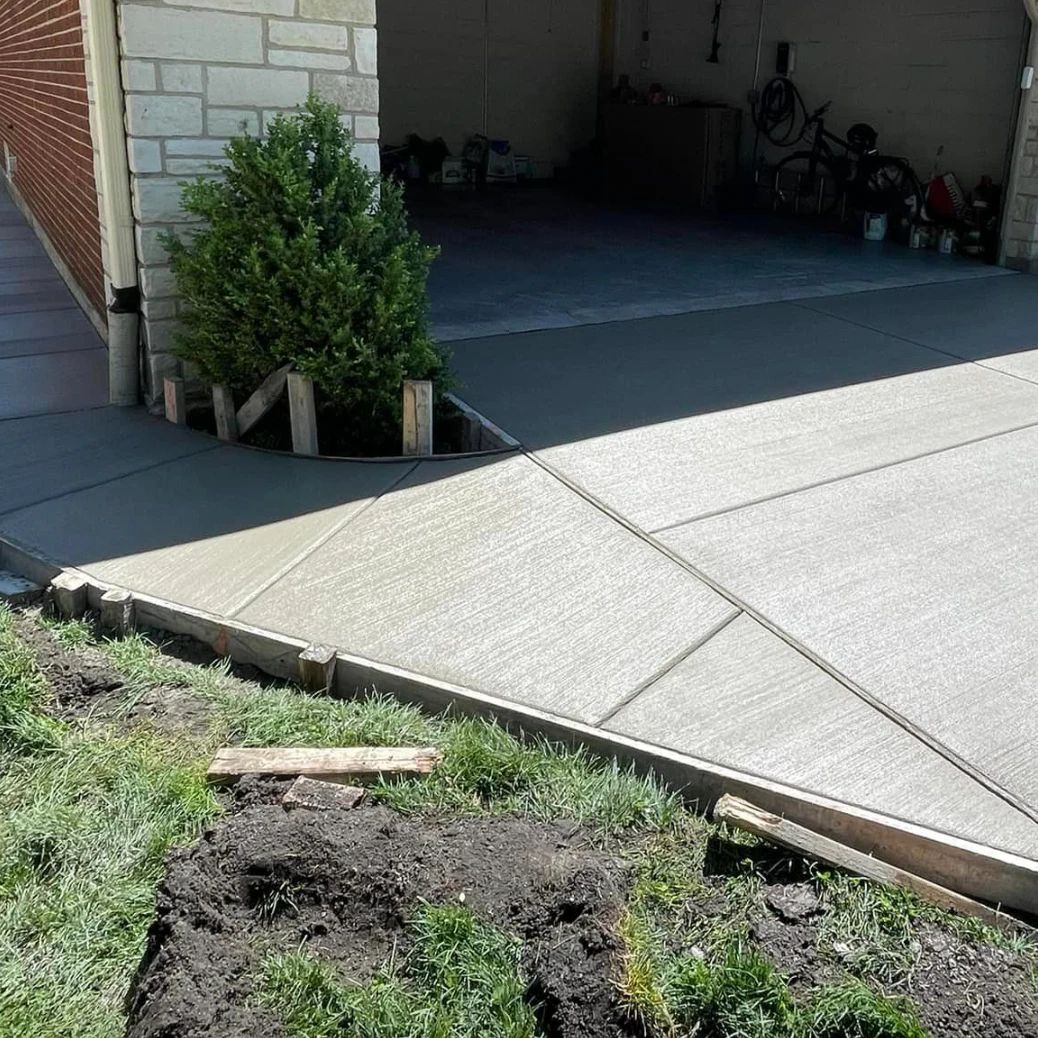
When a Concrete Repair Holds
A repair bonds to the concrete around it and rests on the ground beneath it, so it is only as good as both. Three checks sort most damaged concrete into the right pile, and you can make all three yourself before calling anyone.
- Check whether the slab has moved
Concrete that still sits flat, with no edge standing above its neighbor, has stayed where it was poured, and damage on its surface can usually be repaired. A crack with one side higher, a hump, or a piece that rocks underfoot means the slab has moved. No filler or patch puts it back.
- Check how deep the damage goes
Cement industry guidance written for pavement says a spalled area can be patched when no more than the top third of the slab is damaged and the concrete below is sound. Deeper than that, the repair has to go the full depth, which means cutting the area out.
- Check the ground underneath
A slab that dropped because water washed out its base, or that heaves every winter, will keep doing it. Nothing applied to the surface reaches the base. Taking the concrete out is the only way to dig out soft ground and rebuild it.
Light flaking that stays at the surface is cosmetic and may not need repair at all. Neither do most hairline cracks, because all concrete tends to crack and the joints are there to decide where. The concrete worth acting on is the concrete that fails one of the three checks.
Concrete Repair Options, From a Patch to a Full Tear-Out
Concrete repair runs from leaving a slab alone to pouring a new one, and the jobs in between are done by at least four different kinds of company. Only the last two rows are ours.
| Option | What it does | Where it fits | Where it falls short | Who does it |
|---|---|---|---|---|
| Leave it alone | Nothing. Minor flaking and tight hairline cracks are mostly cosmetic. | A slab that sits flat and is not getting worse. | Damage that keeps spreading has a cause, so look again each spring. | No one. |
| Crack filler or sealant | Closes a crack so water and salt stay out. | A crack under about a quarter inch wide that lies flat. A trade rule of thumb treats it as a temporary repair. | It cannot pull a slab that has moved back into line. | A homeowner, a handyman or a repair company. |
| Patch | Replaces broken-out concrete at the surface with repair material. | Damage in the top third of the slab with sound concrete under it. | Repair material will not match the original concrete. | A concrete repair company. |
| Resurfacing overlay | Bonds a thin new layer over the old surface. | Sound, air-entrained concrete with a worn or scaled top. | No fix for a slab that is heaving, badly cracked or freeze-thaw damaged, and nothing for the soil. | A resurfacing company. |
| Lifting | Raises a sunken slab by pumping cement grout (mudjacking) or polyurethane foam under it. | A slab that sank in one piece on ground that has stopped moving. | Does nothing for concrete that is broken up or flaking apart. | A concrete leveling company. |
| Section replacement | Cuts out the failed panels and pours new ones over a rebuilt base. | Damage confined to part of the slab, with the rest sitting flat. | New panels do not match weathered concrete beside them. | We do. |
| Full tear-out and replacement | Removes the whole slab, rebuilds the base and pours new concrete. | Failure that runs through the slab, or a base that is bad under all of it. | The largest job on the list. | We do. |
If your concrete belongs in one of the first five rows, the fix is usually a smaller job than new concrete, and we will say so on the phone. A crack in a basement or foundation wall is a different trade again. A foundation repair company handles that, as our page on poured foundations and the repair work we leave to others explains.
Concrete Slab Repair, Surface by Surface
The three checks work on any slab, but a driveway, a patio, a walk and a shop floor each fail in their own way, and some of them come with City rules. Steps are their own case, because a stoop sits on a footing: see replacing settled steps and stoops.
Concrete Driveway Repair
A driveway carries the weight and gets the salt. As of 2026 the City of Eau Claire salts only its Ice Control Routes, but cars carry salt and brine home from them, and deicers make freeze-thaw scaling worse. Look first where the driveway meets something else: the garage floor, the walk, and the apron at the street. Look too at any panel beside a downspout, because roof water running under a slab is one way it settles.
When two or three panels have failed and the rest sit flat, replacing those panels is a fair repair. When the cracks wander across the joints, panels have heaved in several places, or the surface is scaling end to end, the whole driveway is the better buy. Full replacement, the City’s apron rules and typical prices are on our page for new and replaced concrete driveways.
Patios and Backyard Slabs
Nothing drives on a patio, so its failures come from water and frost: a slab that tips toward the house, a corner that heaves each winter, scaling where a downspout empties. A patio that sank in one piece is a candidate for a leveling company. One that has broken up or heaved is not.
Section replacement is harder on a patio than on a driveway. Many patios have only a few joints, so there may be no clean line to stop at short of the whole slab. Stamped patios are harder still, because a new section has to match a pattern, a base color and an antiquing color that has weathered for years. More on replacing an old concrete patio, including old decks and paver areas.
Walkways and Entry Walks
Walks fail one panel at a time: one lifts at a joint, a corner breaks loose, or the surface flakes where deicer was spread. Because walk panels are short, a failed stretch can usually be replaced panel by panel, and the City’s own standard for public sidewalks puts the contraction joints no more than 5 feet apart.
The sidewalk along the street is public right-of-way, but in Eau Claire the property owner is responsible for it. If the City has ordered yours repaired, you have 20 days after the Council’s final resolution to choose its contractor or hire your own. The steps, the assessment and the hardship program are under the City’s sidewalk repair program.
Concrete Floor Repair in Shops and Sheds
A shop or shed floor sits out of the weather and the salt, so its trouble is more often support than surface: a corner that settled, a crack under a heavy machine, a floor that has heaved where water gets in under the door. If the floor also carries the walls, it is part of the foundation, and that changes who should look at it.
New floors for outbuildings are covered under new slabs for sheds and shops. Garage floors take road salt and meltwater off the car every winter, so they have our garage floor repair guide to themselves.
Partial Concrete Replacement: Where the Cut Lines Go
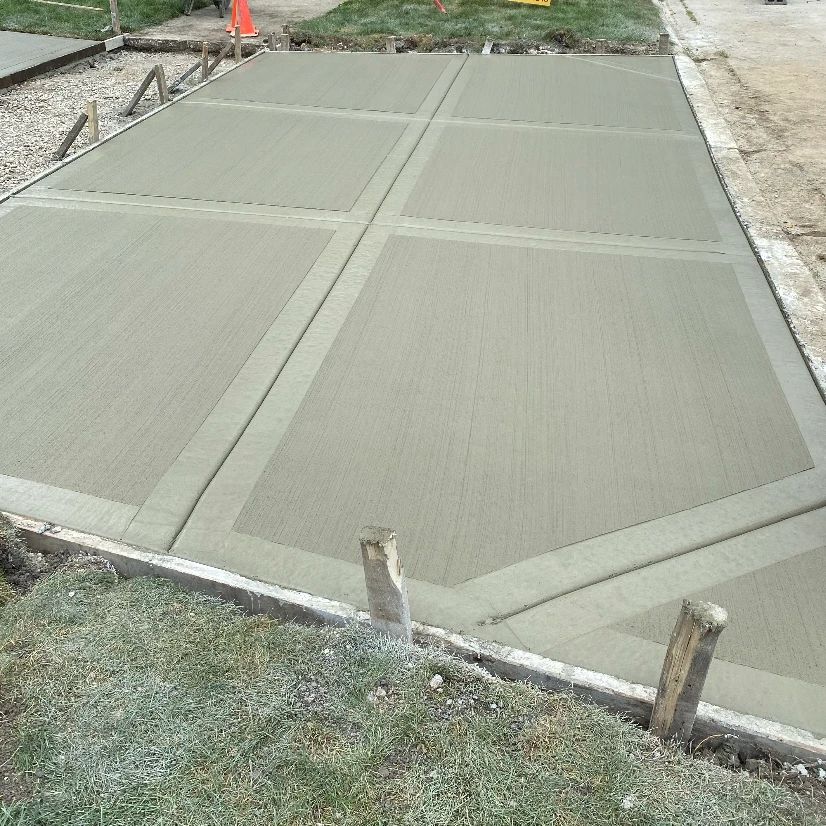
A control joint is a planned crack, a weakened line that lets the slab crack straight instead of at random. That makes the joints the natural edges of a repair. We cut out the failed panels joint to joint and leave the sound ones, so the new concrete starts and stops on lines that were already there. A cut through the middle of a panel leaves a seam that no one planned for.
The Wisconsin Ready Mixed Concrete Association calls for a full-depth isolation joint wherever a new slab meets an existing slab, a structure or another fixed object. Ask how the new section will meet the old concrete, the garage floor and the house before the cutting starts.
With the old panels out, the ground under them is open. Soft or washed-out base is dug out and rebuilt there, which no patch can do.
Two things push a job from a section to the whole slab. One is how far the damage reaches: when it runs across most panels, cutting around it leaves little worth saving. The other is looks. New concrete will not match weathered concrete beside it, and cement industry guidance notes that replacing the whole area may be more cost effective and more uniform looking than partial-depth patching.
Any job that breaks out concrete is digging. State law requires at least three working days’ notice to Diggers Hotline before planned digging, and Saturdays, Sundays and legal holidays do not count. Private lines such as a sprinkler system, ornamental lighting or an electric line to the garage are not marked, so point those out.
Why Concrete Repairs Fail After an Eau Claire Winter
The weak point of any repair is the seam where new material meets old concrete. Water gets into it, freezes, expands and pries it open. A patch over concrete that is already breaking down from freeze-thaw has nothing sound to hold on to.
About 163 days a year reach 32 F or colder at the Eau Claire airport, by NOAA’s 1991 to 2020 normals. Scaling, the flaking of the finished surface, comes from freezing and thawing and gets worse with deicers, too little entrained air, a weak surface or poor curing. A patch fixes none of those causes, so on a slab that scales across most of its surface the flaking keeps coming back around it.
Frost heave needs three things at once: frost-susceptible soil, available water and freezing temperatures. A repair that leaves the water where it was leaves the heave too. Routing a downspout or regrading a low spot is often part of the fix.
New concrete has its own first-winter rule: no deicers, sand for traction, and never a product containing ammonium sulfate or ammonium nitrate. That applies to a single replaced panel as much as to a whole new driveway.
Questions to Ask Concrete Repair Companies
Whoever you call, us included, these questions separate a repair that will last from one that will need doing again.
- What caused the damage? A repair that leaves the cause in place, such as a downspout emptying under the slab, comes back.
- Is the repair full depth or surface only? A surface repair needs sound concrete under it. Ask how deep the damage goes and how they know.
- Where will the cuts fall? New edges should land on joints, and the new concrete should be isolated from what it meets.
- What happens to the base? If concrete is coming out, ask whether the ground under it will be dug out and rebuilt where it is soft.
- Will it match? Ask how much of the slab would have to go for it to look uniform, then decide whether that matters on this surface.
- Who handles the permit? Work at the street end is in the City right-of-way. Ask Engineering at 715-839-4934 whether it needs a permit.
- Is it in writing? Wisconsin’s home improvement rule covers building, replacing or repairing driveways, sidewalks and patios on residential property. When you pay anything before the work is done, it calls for a signed written contract stating the work and principal materials, the total price, and the start and completion dates.
Calling Us About Concrete Repair in Eau Claire
Tell us what the three checks at the top of this page turned up: whether the concrete has moved, how deep the damage looks, and where the water goes. Say what kind of surface it is and roughly how much of it is failing, and send a photo if you can.
If the answer is a sealant, a patch or a leveling crew, you will hear that on the call. If the concrete needs replacing, we measure on site and write up the scope and the price. We are a concrete replacement contractor in Eau Claire working in Eau Claire, Altoona, Chippewa Falls and nearby Chippewa Valley towns, and the rest of our work, along with what we refer out, is on the page of concrete services we take on.